Starting from Zero: How to Begin Learning Russian in Russia
Can you learn Russian from zero in Russia, without knowing any Russian at all? Yes. At immersion schools, complete beginners are common, not the exception. At PRIVET! in Kaliningrad, about 30% of our students start from zero (level A0), and most others arrive with basic Russian. With 20 lessons a week in mini-groups of 2-4 and daily immersion outside the classroom, most beginners can read signs, order food and hold a simple conversation within their first two weeks. Full A1 takes at least 120 hours, about 6 weeks.
I get this question almost every week, usually from someone who has never studied Russian and is nervous about "wasting" a trip to Russia because they "won't understand anything anyway." I've been running this school since 2003, and I can tell you the opposite is true: the less Russian you know before you arrive, the more dramatic your progress will feel. Beginners have the most room to grow, and immersion is exactly the environment that grows it fastest.
This guide walks through what "starting from zero" actually looks like when you learn Russian in Russia at our school: how many students are genuinely in your position, how the beginner course is structured week by week, a realistic timeline for what you'll be able to do after two weeks, and the practical decisions (accommodation, lesson mix, pre-arrival prep) that make the biggest difference to how fast you progress.
How many students learn Russian from zero? Here's the data
Over 23 years we've taught 1,800+ students from 40+ countries. When people imagine a language school abroad, they often picture a room full of confident intermediate speakers polishing their grammar. That's not what our classrooms look like: about 30% of PRIVET! students are complete beginners, and most of the others arrive with only basic Russian.
| Student profile | Share / figure |
|---|---|
| Starting from zero (A0) | about 30% |
| Mini-group size | 2-4 students |
| Typical first stay | 75% stay 1-2 weeks (avg. 15 days) |
| School rating (languagecourse.net) | 5.0 - listed among the 12 best schools in Russia |
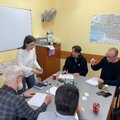
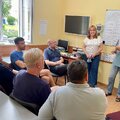
This matters because it shapes how the school actually runs. Our teachers (5 in-person, 11 online) aren't occasionally handling a beginner as a special case. Beginner-track teaching is our core competency, refined over two decades, not an afterthought bolted onto an intermediate curriculum. And with mini-groups of just 2-4 students, nobody gets lost at the back of the room.
Key takeaway: if you're worried that "everyone else will already speak Russian," relax. Statistically, a large share of the room started exactly where you are, and your group will be matched to your level.
How the Russian course for beginners in Kaliningrad is structured
Complete beginners join our dedicated beginner program, built specifically for A0 students with zero prior exposure to Cyrillic or Russian grammar. The structure is intentionally intensive, because short stays (our average is 15 days) demand fast, compounding progress rather than a slow drip of one lesson a week.
Weekly format of the beginner course
- 20 lessons per week - the standard intensive load for in-person beginner students, split between mini-group and individual instruction.
- Mini-groups of 2-4 students (14-18 EUR/lesson; 280 EUR for a 20-lesson week) for core grammar, vocabulary and conversation practice with peers at the same A0-A1 level.
- Individual lessons (18-22 EUR, 45 min; 440 EUR for a 20-lesson week) to target your specific gaps: pronunciation, reading Cyrillic, or accelerating past a sticking point the group pace doesn't address.
- Online option (16-18 EUR, 45 min) for those who want to start before arrival, or continue after returning home. Lessons run on Edvibe and Teams, and with 11 online teachers this is a genuinely large program, not a side offering. See our online Russian lessons for details.
Enrollment is a one-time 80 EUR fee (level test, materials, school events, course certificate). From 5 weeks of study, the rate drops to 14 EUR per group lesson and 18 EUR per individual lesson - worth knowing if you're planning a longer beginner-to-intermediate stay. For accommodation, visa and travel costs on top of tuition, see our full 2026 price breakdown.
What the first days actually cover
Day one is the Cyrillic alphabet and basic sound-letter correspondence; most students can read simple words by the end of day one or two. From there the program moves through greetings, numbers, basic verb conjugation (present tense), simple question formation, and survival phrases for shops, cafés and transport. By the end of week one, a motivated beginner is holding short, real conversations - not reciting memorized lines, but actually constructing sentences.
How long to learn Russian to A1: week-by-week timeline
People often ask how fast they'll "actually" progress, as opposed to marketing promises. Here's the realistic picture based on our beginner-track pacing with 20 lessons/week of immersion instruction plus daily exposure outside class.
| Timeframe | Typical milestone |
|---|---|
| Days 1-2 | Cyrillic alphabet readable; basic greetings and numbers |
| End of week 1 | Simple present-tense sentences; ordering food, asking directions |
| End of week 2 | Reading signs, ordering, simple conversations - a strong start, but not yet A1 |
| About 6 weeks (120 hours) | A1: predictable everyday situations, slow and clear speech on familiar topics |
| About 9-10 more weeks (180-200 hours) | A2 |
| About 8-9 more weeks (160-180 hours) | B1 - around 500 hours in total, closer to 600 in practice |
Visible progress in two weeks is realistic precisely because immersion does half the teaching for you. A lesson introduces a phrase; twenty minutes later you're using it to buy bread, ask a price, or order a coffee. That repetition, with real stakes, is what a classroom-only course at home can't replicate.
To be honest about the table: two weeks from zero means handling the most predictable situations (introducing yourself, shopping, asking simple questions), not fluency. That's still a strong start for most of our students, since 75% of them stay 1-2 weeks. Many beginners then continue with online lessons after they fly home, so the momentum from Kaliningrad doesn't fade.
Common mistakes absolute beginners make - and how the program avoids them
After 23 years of first-time beginners, a handful of patterns repeat. I'll flag them here because knowing about them in advance changes how you approach the first days. (If you're still comparing schools, our checklist on how to choose a Russian language school covers what to ask before you book.)
- Trying to translate everything in your head. Beginners who insist on mentally translating every sentence from their native language stay slower for longer. The mini-group format is deliberately conversational from day one, which trains you out of this habit faster than solo study ever does.
- Skipping the Cyrillic alphabet stage. Some students want to jump straight to "useful phrases" using transliteration and skip learning to actually read. It feels faster in week one and costs you in week two, once vocabulary, menus and signs are all in Cyrillic. Our beginner-track teachers don't let students skip this; it's built into day one for a reason.
- Underestimating how much a host family helps. Students who book the cheapest apartment option to save money sometimes regret it once they realize how much of their progress at this level comes from unplanned conversation, not just scheduled lessons.
- Booking too few lessons to "test the waters." A handful of lessons a week barely outpaces forgetting. The reason we run beginners at 20 lessons/week isn't sales volume: below a certain intensity, a short 1-2 week stay simply doesn't produce a visible level jump.
Why Kaliningrad works for learning Russian from zero
Kaliningrad is a genuinely useful place to learn Russian in Russia as a beginner, for reasons that are more practical than romantic (for a comparison with other cities, see our guide to the best places to learn Russian in Russia):
- Few English speakers. Outside class, you're pushed to use what you just learned rather than defaulting to English. This is the single biggest accelerator for absolute beginners.
- Just 600 km from Berlin. There are direct buses from Berlin, Stuttgart, Hannover and other German cities, and from Gdańsk (there are no direct flights from the EU).
- E-visa. 50-60 EUR, roughly 4 working days to process, no embassy visit required, valid for a 30-day stay and available to citizens of 64 countries. It removes the usual visa barrier that stops people from just trying a short program. See our e-visa guide for the exact steps.
- Bildungsurlaub-accredited in five German states (Brandenburg, Hamburg, Rheinland-Pfalz, Niedersachsen, Thüringen). Your employer keeps paying your salary for the leave days, while you pay for the course yourself.
Russian homestay for beginners: the host family bonus
Accommodation choice matters more for beginners than for any other level, and host family is consistently our most popular option, for a simple reason: it turns "off hours" into extra practice hours.
At 250 EUR/week with breakfast, a host family gives a beginner two things a private apartment (140-250 EUR/week) can't: a patient conversation partner every evening, and constant low-stakes exposure to real spoken Russian, the kind that isn't slowed down for a textbook dialogue. For someone at A0-A1, even simple kitchen-table small talk ("how was your day," "what did you learn today") reinforces classroom material within hours instead of days. Former students describe what this is like in our article on the Russian homestay experience.
It's not the only option. Apartments suit students who want full independence, especially longer-stay relocators (about a third of our recent students arrive under Decree 702 and often prefer their own space). But for a first-time beginner on a 1-2 week intensive, host family is where we see the fastest confidence gains (host family stays run up to 4 weeks; longer stays move to a student or private apartment).
Practical tips for starting Russian from zero
- Don't pre-study for weeks before arriving. A light pass over the Cyrillic alphabet is useful; grinding grammar apps for months beforehand often just builds anxiety. Let the intensive program do the structured teaching.
- Book more lessons than feels necessary. Given 75% of students stay only 1-2 weeks, the 20-lessons/week intensive format exists specifically to compress a semester's worth of progress into days. Don't underbook and then wish you'd had more contact hours.
- Choose host family if you can. The evening reinforcement is the closest thing to a progress "cheat code" we've seen in 23 years of running the school.
- Mix mini-group and individual lessons. Groups build conversational rhythm with peers; individual lessons fix your specific weak points fast. The combination outperforms either alone.
- Use online Russian lessons before or after your trip. Starting a few online lessons (16-18 EUR per 45 min) before arrival takes the edge off day one; continuing afterward protects the progress you made in Kaliningrad.
- Expect Cyrillic to stop being scary within 48 hours. It looks intimidating on paper; in practice, it's a phonetic alphabet you can decode faster than most people expect.
Ready to start? Contact us for a free consultation - the placement test is included in the 80 EUR registration fee.
FAQ: learning Russian from zero in Russia
-
Can I really learn Russian in Russia with zero prior knowledge?
Yes. About 30% of our students start from zero, and most others arrive with only basic Russian. The beginner program is built around this reality, not designed for intermediate students and adapted downward. Teachers, materials and pacing all assume you're starting from the alphabet, and mini-groups of 2-4 keep everyone at the same level.
-
How many lessons per week should a beginner take?
Our standard intensive beginner format is 20 lessons per week, combining mini-group (14-18 EUR/lesson) and individual (18-22 EUR, 45 min) instruction. A full 20-lesson week costs 280 EUR in a mini-group or 440 EUR one-to-one. Since most students only stay 1-2 weeks (average 15 days), this intensity is what makes visible progress possible in a short trip.
-
How long does it take to learn Russian to A1 from zero?
Typical pacing: readable Cyrillic within 1-2 days, simple present-tense conversation by the end of week 1, and by the end of week 2 reading signs, ordering food and simple conversations - not yet A1. Full A1 takes at least 120 hours, about 6 weeks, assuming the 20-lessons/week intensive format plus daily immersion outside class.
-
Do I need a visa, and is it complicated for a short beginner course?
Most students use Russia's e-visa: 50-60 EUR, roughly 4 working days to process, no embassy visit, valid for a 30-day stay and available to citizens of 64 countries - well suited to a 1-2 week beginner program. See our e-visa guide.
-
Is host family or apartment better for a beginner?
Host family (250 EUR/week, breakfast) is our most popular choice and generally best for absolute beginners, since it adds daily conversation practice outside the classroom. Host family stays run up to 4 weeks. Apartments (140-250 EUR/week) suit students who prefer independence, especially longer stays.
-
Why learn Russian in Kaliningrad as a beginner?
Kaliningrad is 600 km from Berlin, with direct buses from several German cities, and has few English speakers, meaning beginners are pushed to actually use their new Russian rather than fall back on English. It's also Bildungsurlaub-accredited in five German states.
Sources
- FSI Language Difficulty Rankings - U.S. Foreign Service Institute: Russian is Category III, requiring 1,100 class hours for proficiency
- Common European Framework of Reference (CEFR) - Standard proficiency levels A1-C2 used by European language schools
- How Long Does It Take to Learn Russian? - Research-based estimates for reaching conversational Russian from zero
- LanguageCourse.net: Russian Schools - Independent student reviews and school comparisons
About the Author
Irina Vinokurova is the founder and director of PRIVET! Russian Language School in Kaliningrad, Russia. Since 2003, she has built the school from a solo teaching practice to a team of 16 teachers (5 in-person, 11 online), serving 1,800+ students from over 40 countries. The school holds a 5.0 rating on languagecourse.net and is Bildungsurlaub-accredited in five German states.
Irina responds to every inquiry personally. Sixty percent of new students come through word-of-mouth recommendations from former students.
- WhatsApp: +7 911 476-25-49
- Email: privet@myrussian.ru
- Website: myrussian.ru
"I've watched hundreds of complete beginners walk into our school not knowing a single Cyrillic letter and leave two weeks later holding real conversations. That gap - between 'I can't read this alphabet' and 'I just ordered dinner in Russian' - is the whole reason I've run PRIVET! for 23 years. It doesn't take fluency to feel like a different person in a new language. It takes about two weeks of the right kind of immersion."
- Irina Vinokurova, founder, PRIVET! Russian Language School, Kaliningrad
Keep reading
- Best Places to Learn Russian in Russia: 2026 Guide - 12 min read
- How Much Does It Cost to Learn Russian in Russia? 2026 Prices - 10 min read
- Russian Homestay: Living with a Local Family - 9 min read
- How to Choose a Russian Language School: 7 Things to Check
Topic map:
| 🏙 Where to Study | ¤ Costs | 🏠 Accommodation | 🛂 Visa |
|---|---|---|---|
| Best Places in Russia | 2026 Prices | Homestay Experience | E-Visa: 30 Days |
Categories: Learning Russian · Study in Russia
Ready to learn Russian from zero?
Explore the beginner program, check why Kaliningrad works for learning Russian in Russia, or read about host family accommodation. When you're ready, book your course → or write to Irina directly: WhatsApp · privet@myrussian.ru