How to Choose a Russian Language School: 7 Things to Check
Blog › Learning Russian › How to Choose a Russian Language School
Irina Vinokurova, founder of PRIVET! Russian Language School · July 10, 2026 · 11 min read · Beginner-friendly

What you'll learn
- 7 specific criteria to evaluate any Russian language school in Russia before booking
- Red flags that signal hidden fees, oversized classes, or outdated programs
- How to verify accreditation, teacher qualifications, and student reviews yourself
- What real student inquiries reveal about the biggest concerns when choosing a school
- Two comparison tables: maximum class sizes at major Russian language schools, and a 7-point checklist comparing the industry norm with PRIVET!
⏱ Helps you decide in 15 min · Beginner-friendly · Works for any school, in any Russian city
Questions about choosing a school? Irina answers personally: WhatsApp · Email
How do you choose a Russian language school in Russia? Check 7 factors: accreditation, teacher qualifications, class size, accommodation, visa support, student reviews, and price transparency. A school that passes all 7 is worth your time and money; a school that fails two or more should make you walk away. I have run PRIVET! Russian Language School in Kaliningrad since 2003 and worked with 1,800+ students from 40+ countries, so this is the checklist I wish someone had given me when I started advising students on this decision.
Full disclosure: I run one of the schools in this comparison. I have tried to make every criterion useful for evaluating any school, including ours, and I will tell you honestly if another school suits you better.
Checklist: 7 Criteria for Choosing a Russian Language School in Russia
- Accreditation and recognition - government license, independent ratings
- Teacher qualifications - RFL-certified (Russian as a Foreign Language), years of experience
- Class size - maximum students per group (not average)
- Accommodation options - host family, residence, or independent
- Visa support and location access - e-visa availability, invitation letters, logistics
- Student reviews and track record - verified reviews, years in operation, repeat rate
- Price transparency - all fees visible on website, no surprises after booking
Topic Map
| 🏙 Where to Study | ¤ Costs | 🎓 For Beginners | 📋 Bildungsurlaub |
|---|---|---|---|
| Best Places in Russia | 2026 Prices | Starting from Zero | Paid Leave to Learn |
Let me walk you through each criterion with specific things to look for and the red flags I have encountered over two decades in this industry.
1. Accreditation: Is the Russian Language School Licensed and Recognized?
Key takeaway: A legitimate school holds a government education license and appears on independent review platforms. If a school cannot show you its license number or has zero third-party reviews, that is your first red flag.
Accreditation is the foundation. In Russia, language schools need a state education license to operate legally and issue study invitations for visas. Without it, a school cannot provide the documents you need for a study visa - and you have no legal recourse if something goes wrong.
But a government license is the minimum. What separates good schools from the rest is independent recognition. Look for ratings on platforms like languagecourse.net, Google Reviews, or Facebook - places where the school cannot edit what students say.
What to check:
- State education license (ask for the number if it is not on the website)
- Presence on independent review platforms with verified student ratings
- Bildungsurlaub accreditation (relevant for German employees - only a handful of Russian schools have this)
- Years in operation - longevity matters in an industry where schools open and close regularly
Red flags:
- No license information anywhere on the site
- Reviews only on the school's own website, nowhere else
- School founded recently with no verifiable track record
At PRIVET!, we hold a Russian state education license, are rated 5.0 on languagecourse.net (listed among the "12 best schools in Russia"), and have Bildungsurlaub accreditation in 5 German states: Brandenburg, Hamburg, Rheinland-Pfalz, Niedersachsen, and Thüringen. Under Bildungsurlaub, your employer keeps paying your salary for the days of educational leave, while you pay for the course yourself. We have been operating since 2003 without interruption.
2. Teacher Qualifications: Who Will Actually Teach You Russian?
Key takeaway: Your teacher should hold a degree in Russian as a Foreign Language (RFL) or linguistics, not just be a native speaker. The difference between a trained RFL teacher and a native speaker "teaching on the side" is the difference between structured progress and expensive conversation practice.
Native speaker does not mean qualified teacher. Teaching Russian to foreigners is a specialized skill - explaining cases, aspect pairs, or verbs of motion to someone whose language has none of these concepts requires specific training and methodology.
What to check:
- Do teachers hold degrees in RFL (Russian as a Foreign Language) or applied linguistics?
- How many years of experience teaching foreign students?
- Does the school list teacher profiles on its website?
- Student-to-teacher ratio across the school (not just per class)
Red flags:
- "Native speakers" listed as the only qualification
- No teacher information on the website at all
- High teacher turnover (check if the same names appear across years of reviews)
Our 5 in-person teachers and 11 online teachers all hold RFL qualifications. Not ready to travel yet? Start with online Russian lessons - EUR 16-18 per 45-minute lesson via Edvibe or Teams, depending on how many hours you book. Several of our teachers have 10+ years of experience specifically with foreign students. Since about 30% of our students arrive as complete beginners, our teachers are trained to work from zero - starting with the Cyrillic alphabet and building systematically from there. If you are starting from zero, ask any school you are considering how many beginners they teach. A school that primarily serves intermediate or advanced students may not have the right methodology for you.
3. Class Size: Ask for the Maximum, Not the Average
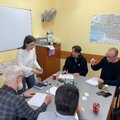
Key takeaway: Ask for the maximum group size, not the average. A school that says "average 5 students" might put you in a group of 12 on a busy week. At PRIVET!, our maximum is 4 - that is a hard cap, not an average.
Class size directly affects how much you speak during a lesson. In a group of 12, you might get 4-5 minutes of individual speaking time per hour. In a group of 4-6, that number triples - and in a mini-group of 2-4, you speak even more.
What to check:
- Maximum group size (not average)
- Whether the school guarantees the maximum or treats it as a guideline
- What happens if your level does not match anyone else's group
Red flags:
- Only "average" group size listed, no maximum
- Maximum of 10-15 students (industry standard, but not ideal for learning)
- No information about group sizes on the website at all - surprisingly common
Here is how major Russian language schools compare on maximum group size:
| School | City | Max group size | Stated on website? |
|---|---|---|---|
| Liden & Denz | Moscow / St. Petersburg | 12 | Yes |
| Educa | St. Petersburg | 12 | Yes |
| ProBa | St. Petersburg | 10 | Yes |
| PRIVET! | Kaliningrad | 4 | Yes |
Figures as published on each school's website. Policies change, so always confirm the current maximum with the school before you book.
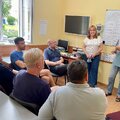
Our mini-groups of 2-4 students mean each person gets meaningful speaking practice every lesson. This is not a marketing claim - it is a structural decision we have kept since 2003 because it works.
4. Accommodation: Host Family, Student Apartment, or Your Own Place
Key takeaway: Where you live during your course shapes your progress as much as the classroom does. For beginners, a host family is the single biggest accelerator - it gives you Russian conversation every morning and evening, not just in class.
Accommodation is one of the top concerns students raise. In our correspondence with students, housing type and host family availability were among the most frequently discussed topics.
What to check:
- Does the school offer host family accommodation? (Not all do)
- Are host families vetted and regularly evaluated?
- What is included - meals, laundry, private room?
- Alternative options: student residence, apartment, hotel partnerships
Red flags:
- "We can recommend some options" instead of organized accommodation
- No details about what is included in homestay pricing
- Host families not screened or evaluated by the school
At PRIVET!, host family is our most popular option. Our host families in Kaliningrad are long-term partners, not random listings. Homestay costs EUR 250 per week with breakfast, a private room, and daily immersion in real Russian household life. Homestays last up to 4 weeks. For longer stays or more independence, we arrange a room in a shared student apartment (RUB 12,000-14,000 per week) or a private apartment (EUR 140-250 per week). Read more about what homestay life actually looks like in our guide to living with a Russian family.
Not Sure Which School Is Right for You? Send me your dates and goals - I will personally tell you whether PRIVET! is the right fit, or honestly point you elsewhere if another school suits you better. No sales pitch, just advice from two decades of experience. → Ask Irina directly
5. Visa Support: How Easy Is It to Study Russian in Russia?
Key takeaway: Visa logistics are the single biggest barrier to studying Russian in Russia. In our correspondence with students, visa questions come up in most inquiries. The visa type you choose determines whether this process takes 4 days or 4 weeks.
This is where your choice of visa matters enormously. A traditional study visa means an embassy appointment, invitation letter, processing time of 2-4 weeks, fees. The e-visa is different - and it is valid for all of Russia, not just one city.
What to check:
- Does the school provide visa invitation letters?
- Does the e-visa cover your trip? (It is valid for all of Russia, for stays up to 30 days)
- How long before your trip do you need to start the visa process?
- Does the school have staff who handle visa questions in your language?
Red flags:
- "Visa support available" with no specifics
- No information about which visa type applies to your stay
- School does not mention visa at all (a sign they may not handle international students regularly)
For Kaliningrad, as for the rest of Russia, you can use the Russian e-visa: about EUR 50, approved in approximately 4 days, valid for 30 days, no embassy visit required. Citizens of 64 countries are eligible. For 75% of our students who come for 1-2 weeks (average stay: 15 days), the e-visa covers the entire course with room to spare. Date flexibility is a frequent concern in our student inquiries - and the e-visa makes last-minute bookings genuinely possible. Our step-by-step e-visa guide for language students walks you through the application. For longer courses, we issue an invitation for a 3-month student visa.
Getting there matters too. Kaliningrad is 600 km from Berlin, with direct buses from Berlin, Stuttgart, Hanover and other German cities, plus many daily buses from Gdańsk. Write to us - we'll find the best route for you and can buy tickets and Russian medical insurance in advance. For a broader look at how different Russian cities compare for language study, see our 2026 city comparison guide.
6. Student Reviews and Track Record: Can You Verify the School?
Key takeaway: Look for schools with a long track record and reviews on independent platforms - not just testimonials on their own website. A school that has operated for 15+ years with consistent ratings has proven itself through economic crises, pandemics, and policy changes.
Reviews on a school's own website are curated. That does not mean they are fake, but they are selected. Independent platforms - languagecourse.net, Google, Facebook, Trustpilot - give you the unfiltered picture.
What to check:
- Reviews on 2+ independent platforms
- Length of operation (how many years)
- Repeat client rate (students who come back are the strongest signal)
- How the school responds to negative reviews (if any)
Red flags:
- Reviews only on the school's own site
- No reviews newer than 2-3 years
- Defensive or dismissive responses to criticism
Our numbers: 23 years in operation, 1,800+ students, 5.0 rating on languagecourse.net. But the metric I am most proud of is this: over 60% of new inquiries come from personal recommendations. We have not grown through advertising, but through results and word of mouth. If you are still deciding on a city, here is why Kaliningrad works so well for language learners: it is a city where few people speak English, so you practice Russian from the moment you step outside.
7. Price Transparency: What a Russian Language Course Really Costs
Key takeaway: If a school does not publish its prices on its website, ask yourself why. Hidden fees for placement tests, study materials, registration, or "administrative costs" are common in this industry. Every fee should be visible before you book.
Price comes up in many student inquiries - it matters to nearly everyone. But here is what surprised us: almost no one left for a cheaper option. Students care less about the absolute price and more about knowing exactly what they will pay.
What to check:
- Are all prices published on the website? (In your currency, ideally EUR or USD)
- What does the enrollment/registration fee include?
- Are study materials included or extra?
- Are placement tests free or paid?
- Any seasonal surcharges or minimum-stay requirements?
Red flags:
- "Contact us for pricing" (why hide it?)
- Registration fee listed but no explanation of what it covers
- Materials, books, or placement tests charged separately
- Prices only in rubles with no international currency option
At PRIVET!, all course prices are published on our website in EUR. Our enrollment fee of EUR 80 covers the placement test, all study materials, school events and a course certificate - nothing extra to buy. Mini-group lessons: EUR 14-18 per 45-minute lesson (a standard week of 20 lessons: EUR 280). Individual lessons: EUR 18-22 per 45-minute session (20 lessons a week: EUR 440). Host family: EUR 250 per week with breakfast. From 5 weeks of study: EUR 14 per group lesson, EUR 18 per individual lesson. No hidden fees, no surprises. For a full cost breakdown including accommodation and living expenses, see How Much Does It Cost to Learn Russian in Russia?
Two ways to start with PRIVET!
- Come to Kaliningrad: mini-groups of 2-4, host family, e-visa for up to 30 days. Send your dates and get a personal answer from Irina: WhatsApp · Email
- Start from home: the same RFL-qualified teachers, EUR 16-18 per 45-minute lesson. Try online Russian lessons
Checklist Comparison: Russian Language Schools in 2026
| Criteria | What to look for | Industry norm | PRIVET! |
|---|---|---|---|
| Accreditation | State license + independent ratings | License only | License + 5.0 languagecourse.net + Bildungsurlaub |
| Teachers | RFL degree + experience | Native speakers | All RFL-certified, 5 in-person + 11 online |
| Class size | Max 6-8, ideally 6 or fewer (hard cap) | 8-15 | Max 4 (hard cap) |
| Accommodation | Organized host family | "We can help" | Host family EUR 250/week, vetted partners |
| Visa | E-visa or full support | Invitation letter only | E-visa 30 days, ~EUR 50, ~4 days |
| Reviews | 10+ years, independent platforms | Varies | 23 years, 1,800+ students, 5.0 rating |
| Pricing | All fees on website | "Contact us" | Full EUR pricing online, no hidden fees |
FAQ: Choosing a Russian Language School in Russia
-
How do I know if a Russian language school is legitimate?
Check for a government education license (ask for the license number), look for the school on independent review platforms like languagecourse.net or Google Reviews, and verify how long the school has been operating. A school with 10+ years and consistent third-party reviews is a strong indicator. At PRIVET!, our license, history since 2003, and 5.0 independent rating are all verifiable.
-
What is a good class size for learning Russian?
Look for a maximum of 6 students per group. Many schools list "average" sizes of 5-8 but may place you in groups of 10-12 during busy periods. Always ask for the hard maximum, not the average. Smaller groups mean 3-4 times more individual speaking practice per lesson. At PRIVET!, mini-groups have 2-4 students.
-
Do I need a visa to study Russian in Russia?
It depends on the length of your stay. For up to 30 days, citizens of 64 countries can use the Russian e-visa: about EUR 50, approved in approximately 4 days, no embassy visit, valid for Kaliningrad and the rest of Russia. For longer stays, you typically need a study visa processed through an embassy, which takes 2-4 weeks and involves additional paperwork. PRIVET! issues invitations for a 3-month student visa.
-
How much should I expect to pay for a Russian language course?
Group courses typically range from EUR 150-350 per week depending on city and intensity. Watch for hidden fees: some schools charge separately for placement tests, materials, and registration. At PRIVET!, mini-group lessons are EUR 14-18 per lesson (EUR 280 for a standard week of 20 lessons), individual lessons EUR 18-22 (45 min), and the EUR 80 enrollment fee covers your placement test, all materials, school events and a course certificate.
-
Can I study Russian in Russia as a complete beginner?
Absolutely. At PRIVET!, about 30% of students arrive with zero Russian (A0 level). Our beginner courses start from the Cyrillic alphabet and build systematically. With 2 weeks of immersion in Kaliningrad - a city where few people speak English - most beginners can read signs, order food, and hold basic conversations by the end of their course - a strong start, though reaching full A1 on the CEFR scale takes about 6 weeks (120 hours). Learn more on our beginners page.
Sources
- LanguageCourse.net - Independent reviews and ratings of Russian language schools in Russia
- CEFR (Council of Europe) - Common European Framework of Reference for Languages, the standard for measuring language progress (A1, A2, B1)
- Bildungsurlaub.de - Directory of Bildungsurlaub-accredited schools, an independent quality signal for European students
- GoAbroad: Russian Language Programs - Student reviews and accreditation info for study-abroad programs in Russia
About the Author
Irina Vinokurova is the founder and director of PRIVET! Russian Language School in Kaliningrad, Russia. Since 2003, she has built the school from a solo teaching practice to a team of 16 teachers (5 in-person, 11 online), serving 1,800+ students from over 40 countries. The school holds a 5.0 rating on languagecourse.net and is Bildungsurlaub-accredited in five German states.
Irina responds to every inquiry personally. Sixty percent of new students come through word-of-mouth recommendations from former students.
- WhatsApp: +7 911 476-25-49
- Email: privet@myrussian.ru
- Website: myrussian.ru
Related Articles
- Best Places to Learn Russian in Russia: 2026 Guide · 14 min
- How Much Does It Cost to Learn Russian in Russia? · 12 min
- Living with a Russian Family: What to Expect · 10 min
- Why Kaliningrad is Russia's Best Kept Secret for Language Learning · 11 min
- Starting from Zero: How to Begin Learning Russian · 11 min
Categories: Learning Russian · Visa & Travel · Student Life · Study in Russia
Ready to Start? PRIVET! Ticks All 7 Boxes
Your Russian course in Kaliningrad: mini-groups of 2-4, RFL-qualified teachers, host family with breakfast, all prices in EUR with no hidden fees. Kaliningrad is 600 km from Berlin, with direct buses. E-visa: study for up to 30 days, no embassy needed.
Book Your Course → or write to Irina directly: WhatsApp · privet@myrussian.ru