Trans-Siberian Language Journey: Learn Russian on the Train
Yes, you can learn Russian on the Trans-Siberian Railway, and that is exactly what our program is built for. Every year I get some version of the same question from a prospective student: "I want to learn Russian, but I also want to see Russia - not just sit in a classroom." For 23 years, my answer has been the same: learn the language first in Kaliningrad, then board the Trans-Siberian Railway and cross the country using what you just learned. It is a 4-6 week Russian course and journey in one, open to all levels, built as a structured course rather than a tour with lessons attached. It is a Russian language program that ends not with a certificate ceremony, but with 9,288 kilometres of railway and seven time zones between you and where you started.
Key takeaways:
- Two-phase program: intensive Russian course in Kaliningrad, then a supervised journey along the Trans-Siberian Railway.
- Route covers Moscow, Novosibirsk, Irkutsk/Lake Baikal, and Vladivostok - 9,288 km, 7 time zones.
- Small groups (our mini-groups are 2-4 students; travel groups on the route are usually 3-4), built around real conversation, not tour-bus sightseeing.
- PRIVET! has taught Russian in Kaliningrad since 2003, with 1,800+ students so far.
- Open to all levels: an online placement test before the trip splits participants into 2 groups by level, and complete beginners (A0) can join if 2-3 of them sign up.
Dates, current routes and group availability are on the main Trans-Siberian Russian course page. This article explains how this Russian language course and travel in Russia fit together, what the route looks like and who the program suits best.
What Makes This Course Unique
Most language schools sell you a classroom. A handful sell you a "cultural immersion week" bolted onto lessons: a museum visit, a cooking class, a folklore evening.
Ours is different in kind, not just degree. The second half of the program moves your classroom onto a train and doesn't come back. It is Russian immersion in the most literal sense, and language travel where the language comes first.
The logic comes from two decades of watching what actually makes Russian stick. A student can memorize verb aspects and case endings in a classroom in Kaliningrad, Berlin, or anywhere else. What they can't get in a classroom is the moment when they have to ask a stranger in Novosibirsk where the platform is, negotiate a price at a market in Irkutsk, or make small talk with a fellow passenger for six hours between stops - in Russian, with no teacher standing next to them to rescue the sentence.
That moment is where language stops being a subject and becomes a tool. Our program is built to create that moment on purpose, city after city, for two to three weeks straight.
Running this as a structured, recurring Russian immersion program rather than a one-off custom trip takes infrastructure most schools don't build: relationships with rail operators, route planning across a country that spans a third of the globe's longitude, and - most importantly - a teaching team willing to hand students an environment that doesn't speak English.
We have both sides. The classroom side is 5 in-person teachers in Kaliningrad, plus 11 online teachers who run online Russian lessons for prep before departure and follow-up after you return. The route side is the experience that makes the second phase work as a course, rather than just an adventure with a language course attached.
How to Learn Russian on the Trans-Siberian Railway: Two Phases
Phase 1 - Learn Russian in Kaliningrad First
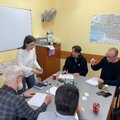
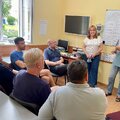
The program starts where every one of our students starts: in Kaliningrad, our home base and - not incidentally - the closest Russian city to Europe (about 600 km from Berlin, with direct buses from Berlin, Stuttgart, Hannover and Gdańsk). Students take individual lessons (18-22 EUR / 45 min) and mini-group lessons (14-18 EUR/lesson), usually staying with a host family (250 EUR/week, breakfast included).
The host family is still the most popular accommodation choice among our students, because it puts Russian in front of you at breakfast, not just in the classroom.
Kaliningrad is also the right place to make early mistakes, which is a big part of why Kaliningrad works so well for learning Russian. It's small enough that you can't hide behind English the way you can in Moscow or St. Petersburg (see our Moscow vs St. Petersburg vs Kaliningrad comparison), and relaxed and affordable enough that the pressure of a first immersion doesn't wreck the budget.
Many of our students arrive with only a small base (A0-A2), so this phase isn't cosmetic. It's where the grammar, the alphabet fluency, and the survival vocabulary actually get built, so that Phase 2 has something to work with.
Phase 2 - The Trans-Siberian Railway Journey
Once the group has a working foundation, we move the whole thing onto the Trans-Siberian route. This isn't a guided tour with a translator smoothing every interaction. It's a small group of 3-4 students travelling together, using Russian to handle real logistics: buying food at station stops, checking into local guesthouses, asking directions, chatting with other passengers in the compartment.
The train itself is one of the best immersion classrooms there is, simply because there is nowhere else to go and nothing else to do for hours at a stretch except talk to the people around you.
Group size is kept deliberately small. With no more than 4 people, nobody can retreat into a corner and let someone else do the talking - which is exactly what happens in larger tour groups. It also means the itinerary can flex around the group's actual level and interests rather than a fixed script.
The Trans-Siberian Route: Moscow to Vladivostok, 9,288 km, 7 Time Zones
The full Trans-Siberian line runs from Moscow to Vladivostok. It is the longest railway line in the world, crossing seven time zones. We don't run the entire line non-stop (nobody should try to learn a language while also losing a week to sleep deprivation). Instead, we build multi-day stops into the cities that give students the best mix of everyday interaction and unmissable scenery.
| Stop | What happens there | Why it matters for the language |
|---|---|---|
| Moscow | Orientation, first days on the route | Biggest city, most Russian-speakers per square metre, easiest place to fail safely |
| Novosibirsk | Siberia's largest city, mid-route stop | Almost no tourist infrastructure aimed at foreigners - real, unfiltered Russian |
| Irkutsk / Lake Baikal | Multi-day stop at the world's deepest lake | Slower pace, longer conversations with locals, informal register of speech |
| Vladivostok | Pacific terminus, program finale | A different Russia entirely - port city energy, a real sense of "we made it" |
Between stops, the train itself is part of the curriculum. There's no lesson plan to follow and few distractions - just hours of compartment conversation with whoever happens to be travelling that day. For many students, these long rail legs are where listening comprehension improves fastest, because the conversation doesn't slow down for them.
Sample 5-Week Russian Immersion Itinerary
Every group's schedule is built around their starting level and available time, but here is a typical five-week structure to show how the two phases fit together:
| Week | Location | Focus |
|---|---|---|
| 1 | Kaliningrad | Intensive individual + mini-group lessons, host family, alphabet and survival grammar |
| 2 | Kaliningrad | Continued lessons, first unsupervised outings using only Russian, review of common errors; at the end of the week the group travels on to Moscow |
| 3 | Moscow | Transition to the road; orientation days; first tests of the language outside a school setting |
| 4 | Novosibirsk → Irkutsk / Lake Baikal | Rail leg with extended conversation practice; multi-day stop at Baikal |
| 5 | Irkutsk → Vladivostok | Final rail leg; program wrap-up on the Pacific coast |
The transfer from Kaliningrad to Moscow is planned together with the group as part of the route logistics, so you don't have to organise it on your own.
Before the trip, every participant takes an online placement test, and we split the participants into 2 groups by level, with lessons held separately for each group. We build the calendar around the group, not the other way around. If you want a head start, begin with a few weeks of online Russian lessons with a native teacher before Kaliningrad - it makes Phase 1 noticeably more productive.
Trans-Siberian Program vs Standard Kaliningrad Course
If you're deciding between the two, here is how they compare on the points that usually matter most:
| Trans-Siberian program | Standard Kaliningrad course | |
|---|---|---|
| Duration | 4-6 weeks in total | Flexible, booked by the week |
| Format | Lessons in Kaliningrad, then 2-3 weeks on the railway | Lessons in Kaliningrad |
| Group size | Small travel group, usually 3-4 students | Individual lessons or mini-groups of 2-4 |
| Start dates | Set once a group is confirmed | Fixed weekly schedule |
| Visa | Usually a 3-month student visa (school invitation) | E-visa for stays of up to 30 days |
| Price | Kaliningrad course prices + route quoted per group | Standard course prices |
Who the Trans-Siberian Russian Course Is For
This isn't the right first step for every student, and I'd rather say that plainly than oversell it. It works best for people who:
- Want a real travel experience across Russia, not just a language certificate
- Are comfortable in a small group of 3-4 people for several weeks - this is not a solo-immersion program and not a large tour group either
- Have 4-6 weeks available, since the combination of a proper language foundation and a real cross-country route doesn't compress well below that
For students who are still at the very start of their Russian and mainly want a shorter, classroom-focused trip, our beginner program in Kaliningrad is the better starting point, and our guide to starting Russian from zero explains what the first weeks look like. Some of those students come back a year or two later, once their Russian is stronger, specifically to do the Trans-Siberian route.
Why Learn Russian With PRIVET! Before the Trans-Siberian
We opened the school in Kaliningrad in 2003, and some version of "go further than the classroom" has been part of how we teach since close to the beginning.
Over that time we've taught more than 1,800 students from 40+ countries, including many from the DACH region (Germany, Austria, Switzerland), where the appetite for a genuinely different kind of trip to Russia has always been strong. We're rated 5.0 on languagecourse.net, one of the independent directories that lists us among the 12 best schools in Russia, and many of our new students arrive through recommendations from people who've studied with us before.
None of that happens by running a generic program. It happens because students remember the ones that were actually different.
The Trans-Siberian course is the clearest example of that difference. It's expensive in time and planning to run well - routing, timing around the school's regular Kaliningrad courses, coordinating a small group across a route that spans a continent - which is probably why few schools offer anything like it.
We've kept doing it because it produces the kind of outcome a classroom alone never quite manages: people who leave not just able to conjugate verbs, but confident they can actually function in Russian, because they just spent two to three weeks proving it to themselves.
Practical Planning: Visa, Prices and Group Dates
A few things worth knowing before you commit to dates:
- Visa: Russia's e-visa is valid for Kaliningrad and the rest of the country - 50-60 EUR, roughly 4 days to process, no embassy visit required, valid for a stay of up to 30 days. This covers Phase 1 comfortably, but the full 4-6 week program runs longer than 30 days. For the complete trip, the school can issue an invitation for a 3-month student visa, and we help each participant choose the right option. Our article on the e-visa for a Russian language course explains the 30-day option in detail.
- Pricing: Phase 1 in Kaliningrad follows our standard course pricing - individual lessons at 18-22 EUR/45 min (18 EUR when studying 5 weeks or more), mini-group at 14-18 EUR/lesson (14 EUR from 5 weeks), plus the 80 EUR enrollment fee and host family accommodation at 250 EUR/week (breakfast included). Full details are on our course prices 2026 page. The railway phase - train tickets, accommodation along the route, and logistics - is quoted per group based on route length and season, since no two Trans-Siberian itineraries cost quite the same.
- Group formation: Because groups are capped at 3-4 people, departure dates are set once a group is confirmed rather than running on a fixed weekly schedule like our standard courses. Check current groups on the Trans-Siberian program page.
If you're weighing this against a standard course, our guide on what it actually costs to learn Russian in Russia breaks down the Kaliningrad side of the budget in detail.
Ready to start? Contact us for a free consultation - the placement test is included in the 80 EUR enrollment fee.
Frequently Asked Questions About Learning Russian on the Trans-Siberian
-
Do I need to already speak Russian to join the Trans-Siberian program?
No. Before the trip, every participant takes an online placement test, and we split the participants into 2 groups by level; lessons are held separately for each group. Even complete beginners (A0) can join if 2-3 of them sign up.
-
How long is the full program?
A typical program runs 4-6 weeks total: 1-3 weeks of intensive lessons in Kaliningrad, followed by 2-3 weeks on the Trans-Siberian route. We adjust the split based on starting level and how much time you have available.
-
Why is the group so small?
Our mini-groups are 2-4 students, and travel groups on the route are usually 3-4. Small groups mean nobody can hide behind another student's Russian. It also lets us adapt stops and pacing to the group's actual level, rather than running a fixed script built for a busload of tourists.
-
Do we cover the whole Trans-Siberian line, Moscow to Vladivostok?
We build the route around Moscow, Novosibirsk, Irkutsk/Lake Baikal, and Vladivostok, with multi-day stops rather than a straight non-stop run of all 9,288 km. That gives students time to actually use the language at each stop instead of just watching the country pass by a window.
-
What visa do I need?
Russia's e-visa is valid for Kaliningrad and the rest of the country: 50-60 EUR, about 4 days to process, no embassy visit, stays of up to 30 days. It's the right entry point for Phase 1. The full 4-6 week program runs longer than 30 days, so for the complete trip the school can issue an invitation for a 3-month student visa - we walk each participant through the right option individually. See our e-visa guide and the article on the e-visa for language students for details.
-
How is this different from a normal Russia tour with a few language classes added on?
A tour is built around sightseeing with language as decoration. Ours is built the other way around: Phase 1 exists specifically to give you the tools you'll need on Phase 2, and Phase 2 exists to make you use them in situations a classroom can't replicate - buying food at a station stop, making conversation with a stranger on the train, asking for directions with nobody to translate for you.
Sources
- Russian Railways (RZD) - Official Trans-Siberian route information: Moscow-Vladivostok, 9,288 km
- Seat61: Trans-Siberian Railway - Comprehensive independent guide to Trans-Siberian routes, tickets, and stopovers
- CEFR (Council of Europe) - Language proficiency framework for measuring progress during immersion travel
- Lonely Planet: Trans-Siberian Railway - Travel guide covering the route, budget, and cultural highlights
About the Author
Irina Vinokurova is the founder and director of PRIVET! Russian Language School in Kaliningrad, Russia. Since 2003, she has built the school from a solo teaching practice to a team of 16 teachers (5 in-person, 11 online), serving 1,800+ students from over 40 countries. The school holds a 5.0 rating on languagecourse.net and is Bildungsurlaub-accredited in five German states.
Irina responds to every inquiry personally. Many new students come through word-of-mouth recommendations from former students.
- WhatsApp: +7 911 476-25-49
- Email: privet@myrussian.ru
- Website: myrussian.ru
Ready to combine a real Russian course with a journey across the country?
Explore the Trans-Siberian ProgramRelated Articles
- Best Places to Learn Russian in Russia: 2026 Guide
- Learn Russian in Russia: Courses in Kaliningrad
- Living with a Host Family in Kaliningrad
Topic Map
| 🏙 Best Places | 🏙 City Comparison | 🎓 For Beginners | ¤ Costs |
|---|---|---|---|
| 5 Cities Compared | Moscow vs SPB vs Kaliningrad | Starting from Zero | 2026 Prices |
Categories: Unique Programs · Study in Russia
Keep Reading
- Why Kaliningrad Is the Best City to Learn Russian - 10 min read
- E-Visa Russia: Study Russian for 30 Days - 10 min read
- Best Places to Learn Russian in Russia - 12 min read
Ready to Start?
Book Your Course → or write to Irina directly: WhatsApp · privet@myrussian.ru